Home / Services / Digital Twins

Service 05 · Digital Twins

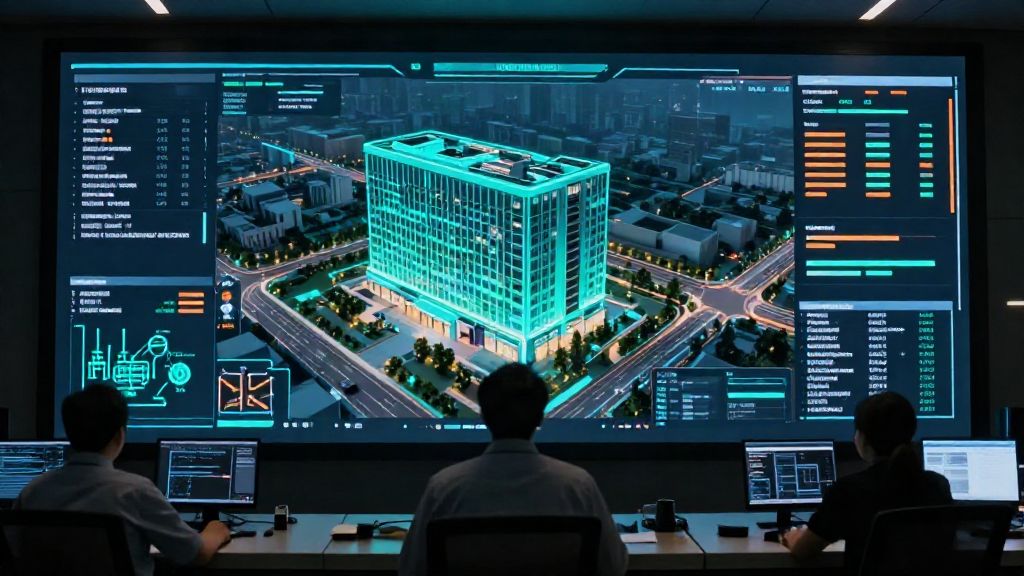
Key Service builds the digital twin of your building: surveyed geometry linked to assets, BMS and IoT sensors, so management data stays tied to real spaces instead of sitting in unread logs. A standalone as-built is a snapshot that ages with every retrofit. We operate from Tirana for facility and asset managers in Italy, Albania and worldwide.

You send the model. We keep it alive.

A digital twin of your building — from the BIM model you have or a fresh survey, updated on an agreed schedule, connected to BMS/IoT where they exist.

BMS · IoTIntegration on standard protocols, scoped and quoted per project
ISO 19650UNI EN ISO 19650 information management

Who does the work

Thirty years of surveying, now keeping models alive.

The digital twin is the natural next step for a business that has produced spatial data and BIM for decades: the same surveys, the same rigour, plus the continuity that turns a model into a management tool.

Team

Technicians dedicated to digital twins — modellers and BIM coordinators, within a floor of 60–70 technicians.

Toolchain

Parametric BIM models in Autodesk Revit as the starting point; the twin lives on a geographic data base that is curated and updated over time — the same discipline as our managed-service contracts.

Credentials

ISO 19650 · UNI 11337.

References — a selection of clients

MISEMISE
Ospedale Militare di BariMilitary Hospital of Bari
Università di BariUniversity of Bari
Reggia di CasertaRoyal Palace of Caserta
Governo di MaltaGovernment of Malta

The problem this solves

A delivered model starts aging the next day.

As-built
A snapshot, not a permanent truth

The building changes. The delivered model does not.

An as-built represents a single moment: the survey. Then come retrofits, changes of use, maintenance. A year later the model no longer matches the building — and whoever manages it works from outdated documentation.

BMS · IoT
Data the building already produces

The systems talk. Nobody is listening.

BMS, meters and sensors produce data every day. Without a model linking it to geometry and assets, it stays in logs nobody opens — and decisions are made on impressions, not evidence.

Academic research reports that few companies in Italy offer digital twins for facility management (Signorini et al., Politecnico di Milano, 2024)


What you get back

A twin that stays aligned with the building.

No platform forced on you: we start from what you have, agree the update frequency and level of detail, and we keep it alive.

DeliverableYou sendWe returnTypical turnaround
Digital twin from an existing BIM model.rvt .ifc model + management scopeNavigable twin + dashboard + update plan4–8 weeks
Digital twin from survey (scan-to-BIM)Point cloud or laser survey + scopeAs-built model + navigable twin8–14 weeks
Periodic twin updatesPartial surveys, changes, plant dataModel aligned to the real state + change logRecurring · every 3–6 months per contract
Facility dashboard & monitoringManagement needs + available dataDashboard for assets, work orders and documents2–4 weeks on an active twin
Sensor / BMS integrationGateway or read access to data (BACnet Modbus KNX)Data flow into the twin + dashboard views4–8 weeks per plant, scoped per project

Turnarounds assume a single building of ordinary complexity and are confirmed in writing before work starts.

It starts from what you already have

Your existing BIM model, a fresh survey or even just the documentation: the twin is built from there, in open IFC formats. No obligation to adopt a proprietary platform.

The twin states its own age

Every update is logged: date, source, author. The model does not pretend to update itself — the frequency is agreed in the contract, and the change log proves it.

One person to talk to

A named project manager for surveys, model, integrations and updates.

The why

Why us, for this specifically.

Off-the-shelf "digital twin" softwareEnterprise platformKey Service
Where it startsFrom their format and their integrationsFrom your data, with integration projectsFrom your survey or model, whatever it is
Who keeps it aliveYou, by hand — or nobodyYour team, after trainingUs, on a contractual schedule
UpdatesAbsent or manualSubscription modulesIncluded in the service, agreed frequency
Point of contactVendor supportEnterprise accountA named project manager, in English or Italian

The global digital twin market grows from USD 21.14bn (2025) to USD 149.81bn (2030), at a CAGR of 47.9% (MarketsandMarkets, 2025); for buildings alone, estimates point from USD 3.2bn (2024) to USD 10.1bn (2030) (Strategic Market Research, 2024).

One supplier, from survey to living twin

Survey, BIM model, data integration and updates: the same team from start to finish. No handovers between whoever surveyed, whoever modelled and whoever has to update.

Continuity is what keeps the twin alive: the people who built it know what every data point means and keep it aligned on every cycle. The model is still true a year from now.

What this makes possible

When the model stops being a document.

How to start

Pick a building. Start with a demo twin.

You do not need a perfect project: just a real building. We show you the twin on your structure before any commitment.

Step one

Demo twin

Fixed fee · limited scope

One floor or one plant room of your building, turned into a navigable twin with the data available. The fastest honest way to judge the service.

Step two

Pilot on one building

Fixed price · fixed scope

One full building, from survey or from the existing model, with a dashboard and a first update frequency agreed in writing before we begin.

Step three

Recurring update contract

Recurring · agreed cadence

The twin stays aligned with the real building: partial surveys, changes and plant data enter the model on every cycle. The same people, every time.

How much does it cost to set up a digital twin?

It depends on the starting point — an existing BIM model costs less than a survey from scratch — and on the integrations requested. After a scope assessment you get a fixed price in writing, before we start.

Do we already need a BMS or IoT sensors?

No. The twin is born from the model or survey alone. BMS and sensor integration is a later layer, assessed and quoted per project on the plant's standard protocols (e.g. BACnet, Modbus, KNX).

How long until it is operational?

From an existing BIM model, typically 4–8 weeks; from a fresh survey, 8–14. Timelines are confirmed in writing before work starts and depend on the agreed scope.

Does the model update itself?

No — no model updates itself. Updates happen through a process and frequency agreed in the contract: that is the difference between an archive and a living twin.

Before you decide

A living twin is a commitment.

The twin becomes the tool your team decides on daily. If the data is wrong or the model is old, your name answers for it. That is why updating is a process, not a promise.

What you can hold us to

  • Every update is logged. Date, source and author of every change: the twin states its own age and provenance.
  • Integrations only for what is actually connected. No promises of sensors or BMS not yet integrated: the scope is defined per project.
  • You hear about a slip from us first. Before your deadline, with what we are doing about it.
  • Come and see it produced. Tirana is an hour from Rome, and you are welcome in the room.

Prefer email? Write to us directly: hello@keyservice.al