The difference in one sentence
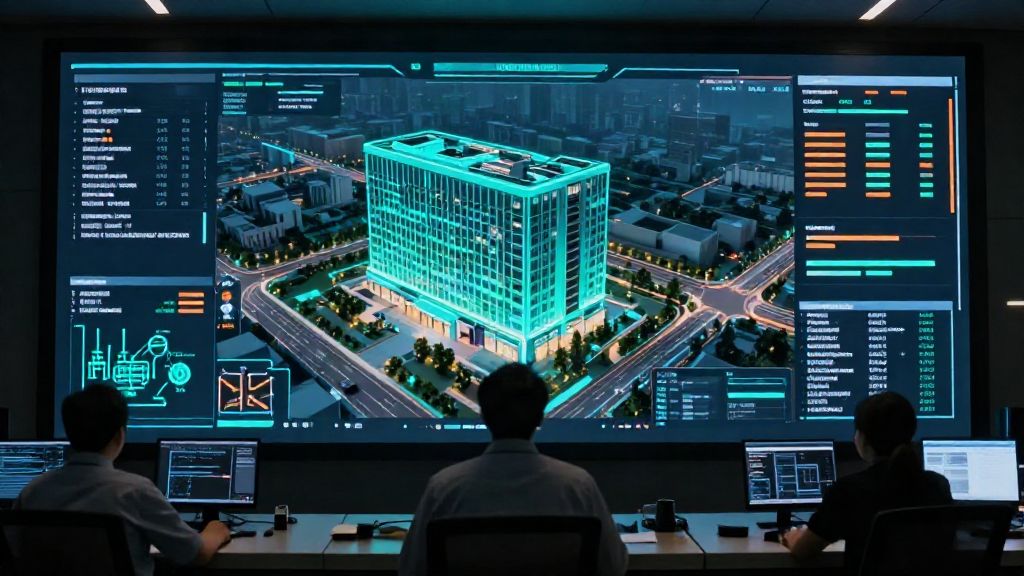
BIM is the building's information model: geometry, data and documents organised for design and construction. The BMS is the system that drives the plant: switching, regulating, raising alarms. The digital twin is the model that stays in service: it starts from BIM (or from a survey of the existing building), connects to plant data and is updated on an agreed schedule. Three roles, three answers to three different questions: what it is made of, how it runs, how it is doing today.
BIM, BMS and digital twin compared
| Criterion | BIM model | BMS | Digital twin |
|---|
| Question it answers | What is the building made of? | How is the plant performing? | How is the building doing, today, as a whole? |
|---|
| What it delivers | 3D model + data + drawings (IFC, .rvt, sheets) | Real-time supervision and control of the plant | Navigable model linked to spaces, assets, documents and data |
|---|
| How it stays current | Updated with every design revision | Lives on field data, but knows nothing of the building | Scheduled, periodic updating of model and data |
|---|
| When you need it | Design, tender, site, as-built handover | Day-to-day plant operation | Managing, maintaining and deciding on the estate over time |
|---|
BIM is the foundation, not the alternative
The first misunderstanding to clear up: the twin does not replace BIM, it presupposes it. Without a structured model — with declared levels of development, object classification and information management per ISO 19650 — there is nothing to attach data and documents to. Owners of existing buildings without a model take the same route in reverse: laser scanning, point cloud, as-built model, and only then the twin. That is the chain of our scan-to-BIM survey service: every step reuses the previous step's data instead of starting over.
The regulatory backdrop pushes the same way. In Italy digital information management methods are mandatory for public works above €2 million since 1 January 2025 (Legislative Decree 36/2023, art. 43, as amended by Decree 209/2024), and the EU EPBD Directive 2024/1275 asks Member States to digitise the building stock. Our BIM modelling service exists for exactly this: producing models that stay valid for years, not just until handover.
The BMS runs the plant; the twin joins model, spaces and data
The second misunderstanding concerns the BMS: "we already have supervision — why would we need a twin?" Because the BMS knows the plant but not the building. It knows a pump is in alarm; it does not know which room it sits in, which ceiling must be opened, or where the current schematic of that system is filed. The twin adds precisely that layer: every asset is located in the model and linked to its room, its documents and its maintenance history.
In technical terms: the twin integrates the BMS, it does not replace it. The connection runs over the plant's standard protocols (BACnet, Modbus, KNX) and must be assessed and priced project by project, plant by plant — beware of anyone promising "real-time integration" without having seen your plant room. And one honest caveat, which we repeat in every proposal: the twin does not update itself. It stays aligned with the real building because someone updates it on an agreed schedule: plant data continuously, model geometry whenever an intervention changes it.
When the model is enough, when you need the twin
The rule is simple. If the goal ends at handover — a tender, a site, a permit, a refurbishment — a good as-built BIM model with declared LODs and tolerances is enough. But if the building must be managed for years — planned maintenance, multiple sites, tenant turnover, energy audits — the handed-over model ages the day after delivery, while the twin remains the daily working tool. The existing stock is the real market: almost nobody manages a brand-new building, almost everybody manages buildings erected decades ago and poorly documented.
The context confirms the direction: the global digital twin market grows from USD 21.14 billion (2025) to USD 149.81 billion (2030), at a 47.9% CAGR (MarketsandMarkets, 2025); buildings alone go from USD 3.2 billion (2024) to USD 10.1 billion (2030) (Strategic Market Research, 2024). In Italy, smart building is worth €1.4 billion inside a €10.9 billion IoT market (+12%) (Internet of Things Observatory, Politecnico di Milano, 2026). Estate managers — property managers, facility managers, technical departments — gain first, because they are the first to pay the cost of outdated documentation.
What to check before choosing
Whether you are procuring a model or a twin, these five questions separate a serious provider from one selling files:
- Declared update frequency: if it is a twin, how often is it realigned — and how is every change evidenced as recorded?
- Real integrations, not promises: which plant and protocols has the provider actually connected, on live cases?
- Open, reusable formats: IFC for the model, .e57/.las for point clouds — or proprietary formats tying you to one platform?
- Level of detail and tolerances up front: declared LOD and permitted deviation from the survey, put in writing.
- Service continuity: who keeps the twin alive between interventions — a named contact or an anonymous ticket queue?
In short
BIM, BMS and digital twin are not three names for the same thing: the model describes, the BMS commands, the twin holds the two together over time. If you manage an estate and the documentation no longer follows reality, the comparison to make is not the file's price but the cost of working without one. Our digital twin service starts from where you are — an existing model or a building to survey — and keeps it alive after handover.
Request a demo twin →